One of the key things about betting on horses is judging weight.
When we say this, it always means the weight each horse carries which then of course affects their performance. Weight carrying is naturally exacerbated in handicap events in which the horses carry different weights according to their official rating.
What Racing Weights are Based On
There are ostensibly two main types of races, each treating racing weight differently; ‘handicap’ races and ‘conditions’ races. Conditions are also often known as ‘weight for age’ events.
Handicaps

In a handicap the idea is that each horse has, in theory, the same chance at the weights. Every horse after they have run three times or won a race is given an official rating. In Britain, this is decided by a team of handicappers at the BHA, including the chief handicapper.
Races are then divided by quality, not only from Class 2 to Class 6, but also featuring a rating range. If a race is designated for those rated 85 and over, then only such horses rated that highly can compete. Some have an upper limit too, such as 85-95.
When this is the case, there will be a designated top weight. On the flat, this may be 9st 7lbs, or ‘9-7’. Should the highest rated horse left in the field be rated 95, they will carry 9-7. A horse therefore rated 92 would carry 3lbs less, in other words 9-4.
Of course, there are myriad factors leading to races never finishing with all the horses in a line. Some horses aren’t in good form and will underperform versus their rating. Some won’t like the ground, while others are improving and can therefore outrun their rating.
As a punter or handicapper, one is always on the lookout for improving types we believe are about to run better than their official rating suggests in handicaps, therefore having ‘weight in hand’.
When a horse runs badly, the handicapper may decide to reduce their rating. When they run well, especially when they win, they almost always go up in the handicap. It’s up to trainers, owners and of course punters at that point to decide whether the horse can cope with the weight hike and win again.
Conditions Races

Also known as ‘weight for age’ races, conditions races do not require runners to carry different weights according to their handicap. Instead, weight reductions or penalties are added to the standard weights depending on the horse’s situation.
For example, if every horse in a conditions event was aged 3 then they would all carry the same weight. If there is a filly in the line-up, they may get a sex allowance of 3lbs or 5lbs depending on the race distance.
If the race is not run at the top level, there may be penalties added for high-profile wins. In a Group 3 race for example, the standard weights may be 9-0. If a horse has won a Group 3 in the last year, they may have to carry 3lbs more. A Group 2 winner may carry 5lbs more and a Group 1 winner 7lbs more.
This keeps things competitive and ensures that a Group 1 winner can’t just turn up and win a Group 3 race easily.
Many conditions races feature horses of varying ages, hence the ‘weight for age’ angle. Even if two horses are said to be of the same ability or in the same grade, a three-year-old will always receive weight from a horse aged four or over owing to their relative lack of strength.
Here’s how it looks on a race card:
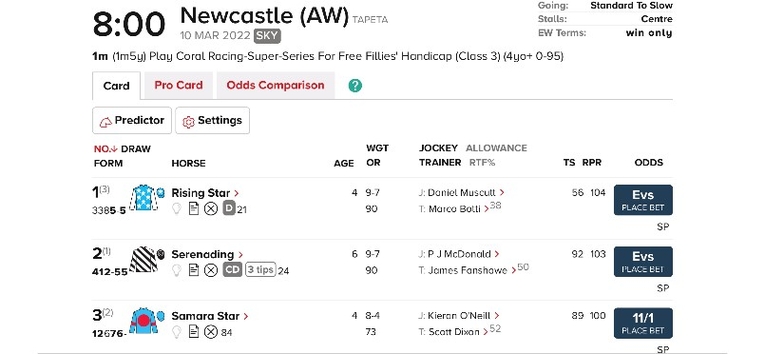
In this case, all of the fillies are aged four or over and this is a handicap race. WGT means the weight being carried and OR is the official rating.
As Rising Star and Serenading are both rated 97, they carry 9-7 which is the allocated top weight for this event. Samara Star is rated only 73, some 17lbs below the others, and therefore carries 17lbs less which in this case is 8-4.
When judging the race as a punter, you may decide that you believe in these conditions that Rising Star may run to just about her handicap mark. You may think that Serenading may not like the surface and may therefore run under her handicap mark.
If you believed however that there was a lot of improvement to come from Samara Star from such a lowly mark and thought she could run to a level closer to 75, 77 or even 80, then she may rate as a bet. Not because she is physically carrying less weight, but simply because she may be better than her current handicap rating.
Equipment

The weight that a horse carries in a race is made up of the jockey’s weight and that of the equipment they carry.
Jockeys must weigh out before the race, then weigh in again afterwards to ensure there are no discrepancies before the result is made official. If you’re at the track you will often here the “weighed in, weighed in” call over the PA when this has been completed.
Nowadays, digital scales are used which are very accurate and the Clerk of the Scales is in charge. Any discrepancies would be reported to the stewards which would then lead potentially to disqualifications.
To ensure horses carry the right weight, small amounts of lead are added to the saddle cloth. The more a horse is required to carry according to the conditions of the race, the more lead is added.
When a jockey weighs out, their own body weight combined with their crop, helmet and saddle are all weighed together. This forms their overall riding weight.
Weight Factors
Even in a handicap race, there are three other factors that can determine the weight carried by a horse apart from its official rating:
- Weight-for-age allowances
- Allowances for apprentice and conditions jockeys
- Penalties
Here’s a bit more detail about each one.
Weight for Age
 Even in handicaps, weight for age can be used.
A three-year-old considered to be a 90 horse would still not be as strong as a four-year-old with the same rating.
The weight for age scale dictates how much weight younger horses are in receipt of. If varies according to race distance and the time of year.
This is why when you see a major handicap race, let’s say in July, and the ages are being mixed.
You may be confused to see one horse rated 90 carrying 8-10 and another with the same rating carrying only 8-3.
This is likely to be because of age.
Jockey’s Allowance
 Younger and less experienced jockeys are entitled to a weight claim. This applies to apprentice jockeys on the flat and conditional jockeys over jumps. The weight claim is in place to essentially offset the rider’s apparent inexperience.
On the flat, apprentice jockeys begin with a 7lb claim. After they ride 20 winners, this reduces to 5lbs, further to 3lbs after 50 wins and after 95 wins they are considered fully professional and have no claim.
Over jumps, they claim 7lbs to 20 winners, this reduces to 3lbs after 40 winners and to zero after 75 winners.
It’s important to note that the weight claim doesn’t appear next to the horse on the race card. If a horse is published with a weight of 10-5 and the jockey has a (5) next to their name, you can take 5lbs off that meaning the real weight is 10-0.
Weight Penalties
 In Britain, the racing week is essentially from Sunday to Saturday. Any ratings which are to be revised by the BHA handicappers will be published the following Tuesday. Any changes then come into effect from the following Saturday.
With this in mind, steps are taken to stop trainers running a fresh horse very quickly without penalty when they have won easily.
A horse with a mark of only 60 may win a race with tons in hand and the trainer knows it cannot be moved up the handicap yet. If they are turned out quickly, they will first be assigned a weight based on their rating but can carry a penalty for winning.
Typically, a flat winner can enter another race before it has been reassessed with a 6lb penalty, while over the jumps the penalty is 7lbs.
This works well for trainers when they know fine well their horse could really reach a rating of 70, 75 or even bigger. Running under a 6lb penalty therefore still gives them a fine chance of following up the win.
Horse Weights

While the subject of weights in racing always means what the horses carry on their backs, it’s high time conversations were had about the weight and size of the animals themselves.
A major bugbear for professional punters is the lack of information given on horses. True, great strides have been made in recent times leading to not only headgear but also wind operation info being shown on race cards, but that’s pretty much where it ends.
If a young horse grows and/or puts weight on over a certain period of time, that would be valuable information to know. That helps punters understand the level of improvement that is perhaps to come from an individual as they fill out and strengthen up.
As technology improves and processes become quicker, it would be brilliant to see the size in centimetres (not ‘hands’) and the weight in kilos of each runner displayed on race cards.