• Skip to primary navigation
  • Skip to main content
  • Skip to primary sidebar

HorseRacingBettingSites.co.uk

Horse Racing Betting Sites

  • Home
  • Bookmakers
  • New Sites
  • Free Bets
  • Betting Guides
  • Racing Terms
  • Racecourses
  • Meetings
  • Horses

Win, Place & Each Way Betting Explained: What’s the Difference?

Single betIn this article we’ll cover the simplest of all the types of bet you can place – the straight win.

This is probably the most widely used bet in horse racing, and although it’s a simple bet, there are a few options to consider nonetheless, as well as an important rule to get your head around.

We’ll also cover the ideas of place and each way betting, which also fit into the ‘simple bet’ category.

These bets can be useful in a number of different scenarios, and a bettor who uses all of the available bet types intelligently and effectively will usually do much better than those who don’t.

Betting on the Win

A win bet is simply a single bet placed on a horse to win a race.

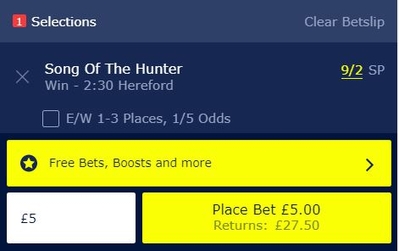
Only the selected horse winning the race will yield a return on the investment. The overall return will always include the stake, so if you place a £10 bet on a horse at 11/4 and it wins, then the return will be £37.50 (11/4 x £10 plus £10 stake).

Take a Price or Gamble on the SP
Odds or Starting Price
Current Odds vs SP

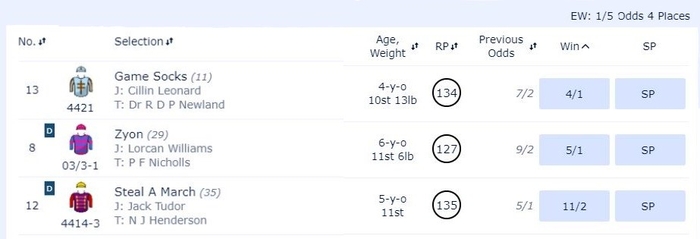
When placing the bet, you will be given a choice of ‘taking the price’ or taking the SP (starting price). Taking the price means that you are committing to the bet at whatever odds the horse is at the time of the bet. This is a balancing act, as the horse may be 3/1 when you place the bet but eventually start at a bigger price, meaning when taking the price you have missed out on a potentially bigger return.

It can of course go the other way, with a horse which is well-backed just before the race naturally shortening in price. To counter this slightly, many bookmakers offer ‘best odds guaranteed’ these days, meaning you should take the price when placing the bet and if the SP is larger, you will receive your winnings at that price anyway removing the price/SP gamble and making the smart money always take a price. However, not all bookmakers offer BOG on all races, so make sure you’re aware of the rules at the site you’re betting on.

Rule 4

If you’ve backed a horse to win at a certain price and it does so but for instance a horse was pulled out at the last minute, then your returns may be subject to a ‘Rule 4’ as mentioned in detail in our rules article, meaning a percentage of your winnings will be kept by the bookmaker.

Place Betting
Place Betting
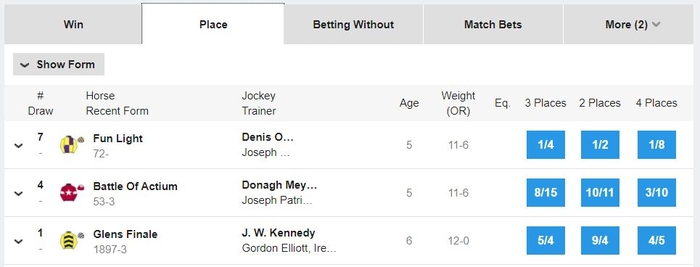
Different Odds for Number of Places

A place bet is something which catches some punters out. In the USA, for example, you can back a horse to ‘win, place or show’. When backing it to ‘place’, it may win or finish 2nd for you to collect. In the UK, a place bet is much more fluid and depends on the conditions of the race and the number of runners.

There are rules set in the UK as to what constitutes a horse having been ‘placed’ in a race:

  • 1 to 4 runners – the horse must win to be considered placed
  • 5 to 7 runners – the horse must finish in the first two places
  • 8+ runners – the horse must finish in the first three
  • 16+ runners (handicaps only) – the horse must finish in the first four

Those are the hard rules, however others apply from bookmaker to bookmaker, i.e. some paying out 1/4 odds while others pay 1/5 of the odds when the horse doesn’t win but is placed. They are all obligated to pay place money on the above, though for races such as the Grand National where there may be as many as 40 runners, some bookmakers will pay 5 or even 6 places as a special offer.

Place bets can be made as a single bet with the Tote, the only instance in the UK of ‘pool betting’. Not just the perceived chance of the runner but also how much money is in the pot overall will dictate what price a punter will get for it to be placed and this changes almost constantly until the race is off.

Each Way Betting
Each Way bet
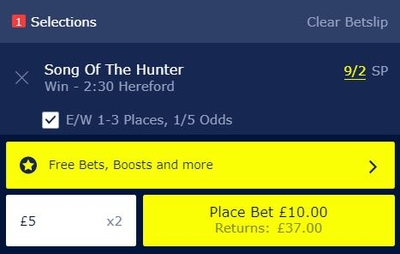
Notice the stake is double as E/W is checked

An each-way bet is a combination of the above, being both a win bet and a place bet. As a punter, you are effectively placing two bets at once in this case. For the ‘win’ part of the bet, the selection must win the race and for the place part the horse must finish ‘in the places’ as directed above.

So, let’s say for example that a horse is 10/1 with the bookmaker offering a quarter of the odds for the first three places and you wish to back it each-way. A £5 each-way bet will actually cost £10 in total.

If the horse were to win; you would receive £55 for the win part (£5 at 10/1 plus your original stake) and another £17.50 for the place bet.

Had the horse finished 2nd or 3rd in this instance, only the £17.50 return would be forthcoming by virtue of your £5 stake going on at a quarter of the actual odds (10/1 effectively becoming 5/2).

Primary Sidebar

Bet Types

  • Ante Post Betting
  • Back to Lay
  • Betting Without
  • Best Odds Guaranteed
  • Each Way Edge
  • Each Way Accumulators
  • Forecast & Tricast Betting
  • Full Cover Bets
  • Cash Out
  • Lay Betting
  • Lengthen the Odds
  • Totepool Betting
  • Unnamed Favourite
  • Flag or Super Flag Bets
  • Round Robin Bet
  • Alphabet Bets
  • Up and Down Bet
  • Starting Price
  • Win, Place & Each Way Betting
  • Winning Distance Betting

Racing Guides

  • Dead Heats
  • Draw Bias
  • Flat v National Hunt
  • Handicapping
  • Grades & Classes
  • Horse Racing Rules
  • Horse Ages
  • How to Bet
  • Calculate the Payout of a Bet
  • One Horse Races
  • Non Runners
  • Reading Form
  • Reserve Horses
  • The Going
  • Race Distances
  • Weights
  • Brought Down
  • Fallers
  • Pulled Up
  • Unseated Rider
  • No Horses in a Race
  • What is a Bumper Race?
  • What Is a Co-Favourite in Horse Racing?
  • What is the Non-Triers Rule?

Races & Courses

  • All Weather Racing Championships
  • All Weather Racing
  • Amateur Races
  • Harness Racing
  • Major Races
  • Racecourse Surfaces
  • Street Racing
  • Richest Races in Racing
  • Types of Race
  • Longest Races
  • Shortest Races
  • Difference Between Fences and Hurdles

General Info

  • Amateur Racing
  • What are "The Classics" in Racing?
  • Can a Jockey Remount After a Fall?
  • Can a Jockey Own the Horse?
  • Can Jockeys, Trainers & Owners Bet?
  • Contaminated Horse Feed
  • Do Horses Usually Have the Same Jockey?
  • Floodlit Racecourses
  • Headgear
  • Horse Racing Bites
  • Horse Racing Cheats
  • People in Racing
  • How Many Races Can a Horse Run in a Day?
  • How Much Do Jockeys Earn?
  • How Often Does a Horse Race?
  • How to Buy a Racehorse
  • Is Horse Racing Fixed or Fair?
  • Jockey Silks
  • Jockeys Weighing in and Out
  • Ladies Days
  • Expensive Racehorses
  • Naming a Racehorse
  • Prize Money
  • Summer Jump Racing
  • Life Stages of Race Horse
  • The Queen and Horse Racing
  • Types of Horses
  • What is a Foal, Filly and Colt?
  • What is a Gelding?
  • What is a Mare in Horse Racing?
  • What is a Ringer in Horse Racing?
  • What is Dutching?
  • What to Wear to the Races
  • Horse Breeds
  • Famous Horses

Courses By Area

  • Berkshire
  • Devon
  • England
  • Ireland
  • London
  • Norfolk
  • Northern Ireland
  • Scotland
  • Surrey
  • Sussex
  • Wales
  • Yorkshire
  • Kent
  • Racecourses

    • Aintree
    • Ascot
    • Ayr
    • Ballinrobe
    • Bangor-on-Dee
    • Bath
    • Bellewstown
    • Beverley
    • Brighton
    • Carlisle
    • Cartmel
    • Catterick
    • Chelmsford City
    • Cheltenham
    • Chepstow
    • Chester
    • Clonmel
    • Cork
    • Curragh
    • Doncaster
    • Down Royal
    • Downpatrick
    • Dundalk
    • Epsom
    • Exeter
    • Fairyhouse
    • Fakenham
    • Ffos Las
    • Fontwell Park
    • Galway
    • Goodwood
    • Gowran Park
    • Great Yarmouth
    • Hamilton Park
    • Haydock
    • Hereford
    • Hexham
    • Huntingdon
    • Kelso
    • Kempton Park
    • Kilbeggan
    • Killarney
    • Laytown
    • Leicester
    • Leopardstown
    • Limerick
    • Lingfield Park
    • Listowel
    • Ludlow
    • Market Rasen
    • Musselburgh
    • Naas
    • Navan
    • Newbury
    • Newcastle
    • Newmarket
    • Newton Abbot
    • Nottingham
    • Perth
    • Plumpton
    • Pontefract
    • Punchestown
    • Redcar
    • Ripon
    • Roscommon
    • Salisbury
    • Sandown Park
    • Sedgefield
    • Sligo
    • Southwell
    • Stratford
    • Taunton
    • Thirsk
    • Thurles
    • Tipperary
    • Uttoxeter
    • Warwick
    • Waterford & Tramore
    • Wetherby
    • Wexford
    • Wincanton
    • Windsor
    • Wolverhampton
    • Worcester
    • York

    Major Meetings

    • Guineas Meeting
    • Aintree Becher Chase Day
    • Ascot King George Diamond Weekend
    • Ayr Gold Cup Day
    • Ayr Scottish Grand National
    • British Champions Day
    • Cambridgeshire Meeting
    • Cheltenham Festival
    • Cheltenham Festival Trials Day
    • November Meeting
    • Welsh Grand National Day
    • Chester May Festival
    • Epsom Derby Festival
    • Glorious Goodwood
    • Grand National Festival
    • Kempton Christmas Festival
    • Leopardstown Dublin Racing Festival
    • Newmarket Craven Meeting
    • Newmarket Future Champions Festival
    • Newmarket July Festival
    • Royal Ascot
    • Sandown Coral-Eclipse Meeting
    • Sandown Tingle Creek Day
    • St Leger Festival
    • York Dante Festival
    • York Ebor Festival

    You must be 18 or older to bet online. Please bet responsibly. For problem gambling see Gamstop.co.uk or GambleAware.org. All bookmakers listed are licensed by the UK Gambling Commission.

    Copyright © 2026, do not reproduce without permission. Contact Us Here