In horse racing, a non-runner (NR) is a horse who was declared to take part in a race but ultimately didn’t face the starter. This is different from a horse who refuses at the start or who doesn’t leave the starting gates after they open.
The term ‘non-runner’ is assigned to a horse regardless of whether it is withdrawn in the moments before post time, or even soon after the final declarations are made which can be two days before the event.
Those classed as non-runners very late in proceedings can affect the betting heavily, which we’ll go through in more detail.
Reasons for Horses Becoming Non-Runners

There are numerous reasons trainers can give for withdrawing a declared runner from a race. Some of those reasons have been tightened up by the BHA in recent times to stop what was seen as an escalation in non-runners.
The reasons give for a non-runner, plus the potential circumstances are:
- Going. The going can change quickly. Horses may be declared on good to firm ground, but should it come up soft on race day trainers have every right to pull their horse out and save it for another day.
- Illness and Injury. Horses may scope badly or suffer an injury after declaration time, therefore be unable to run. A veterinary certificate is usually needed, though trainers can declare a non-runner with a self-certificate.
- Travel. On occasion, problems on the road can lead to horses not getting to the races on time. They can therefore justifiably be declared a non-runner.
- Refusing to Enter the Stalls. In flat racing, horses are given several chances to enter the starting stalls. If they continue to refuse the starter may give up and let the field go without the horse in question. As they haven’t faced the starter, they are official non-runners.
In the case of ‘other’, ‘travel’ or ‘self-certificate’, trainers are required to give more information on the reasons for their horse not taking part.
How Non-Runners Affect Racing Bets

While the timing of a horse being declared as a non-runner doesn’t ultimately affect its status as one, it can affect the betting greatly.
As long as your horse was officially declared for the race before you backed it, in other words you weren’t betting in the ante-post market, then when it is taken out you will receive your stake money back on the non-runner.
When a fancied runner is declared a non-runner, naturally the market on the rest of the runners contracts. This is usually done with plenty of time to spare, often even before many punters have had a bet on the race at all.
Sometimes however a horse is withdrawn from the race very late, often in the moments before the off having given trouble in the stalls or having refused to load. When this is the case, a Rule 4 may come into effect.
Rule 4
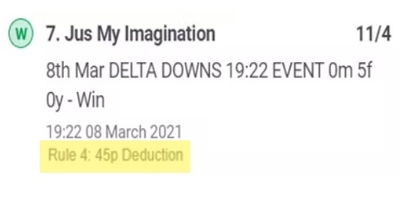 A Rule 4 deduction can be made to winning horse racing bets. This happens when the race and its odds are impacted heavily by a particular horse not running and kicks on when there is not sufficient time for bookmakers to create a new book when a horse is pulled out late on.
The deduction used in Rule 4, or even whether there is one at all, depends on which horse is withdrawn as well as the field size.
Should a horse at 40/1 be withdrawn in a 20-runner race, then a Rule 4 may not be implemented as the withdrawn is thought to have minimal effect on the outcome of the race.
If, however the favourite or second favourite were to be withdrawn, then the odds already displayed remain but Rule 4 will undoubtedly be used. The shorter the price of the runner, the heavier the Rule 4 deduction to all winning bets. Rule 4 may take away 10p, 20p or even 50p in the pound on winning wagers.
Ante-Post v On the Day
 If you place bets before the final official declarations are known, often done days, weeks or even months in advance, then you are betting in the ‘ante-post’ market.
Odds are bigger and more inviting in these markets, but that is reflective of the fact that more potential runners are listed and that you will not get your money back should your horse not run.
In terms of horse racing terminology, a ‘non-runner’ suggests a horse which has been taken out after declaration time which would mean stakes are returned to bettors.
Non-Runners in Accumulators and Pool Bets
Single bet non-runners are easy to manage; if your horse doesn’t run, you get your stake back. It’s that simple. There are many different bets available in horse racing however and they can all be affected differently by non-runners.
Doubles, Trebles and Accumulators
Should you make a multiple bet and one or more of your selections is declared a non-runner, they are simply taken out of the bet and the overall wager shrinks.
A 4-fold with one non-runner simply becomes a treble, a double with a non-runner becomes a single, a 6-fold with two non-runners becomes a 4-fold and so on.
Pool Bets
 Pool betting, such as on the Tote, is also affected by non-runners.
If you place a single bet then the usual rules apply; your stake is returned for the non-runner.
Non-runners are more likely however to affect multi-leg Tote bets such as Jackpot, Quadpot and Placepot bets.
In this case, whenever your horse doesn’t run the stake is automatically placed onto the eventual favourite.
That favourite could change at the very last second, so you may not know which horse your bet is going on until the result is already known.
Reducing Non-Runner Numbers

In Britain, there has been an increase in non-runners and as a separate issue, smaller and smaller field sizes in the past few years.
In order to combat this, the racing authorities are looking to address the issue of non-runners which in part is being done to protect punters.
Some of the things the BHA have done to try to tackle the increase in non-runners are:
- Introducing 49-hour declarations. Final declarations two days before a race have been commonplace in flat racing for some time. In jumps racing, the practice is only used for certain high-profile races. 48-hour declarations means that trainers have two full days to discover any problems and take their horses out.
- Stewards’ investigations. Race day stewards can investigate runners who are declared fit but are withdrawn due to ground conditions. They do this whenever a horse has previously run on the same ground they are being declared a non-runner on.
- Banning self-cert. Trainers are allowed to use self-certification. However, should they have 100 or more declarations and a non-runner rate of 50% or more then they can be banned from self-certs for as long as twelve months.